
Honoring UMass Amherst’s Black Pioneers
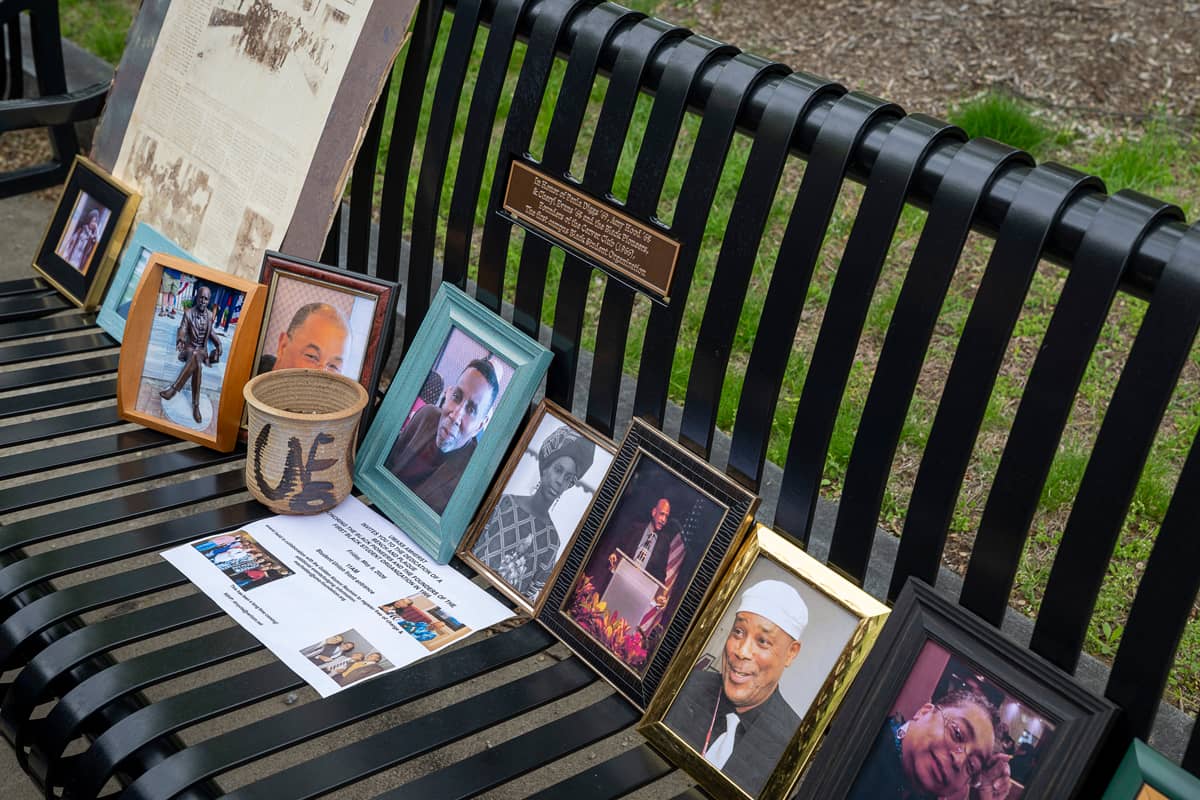
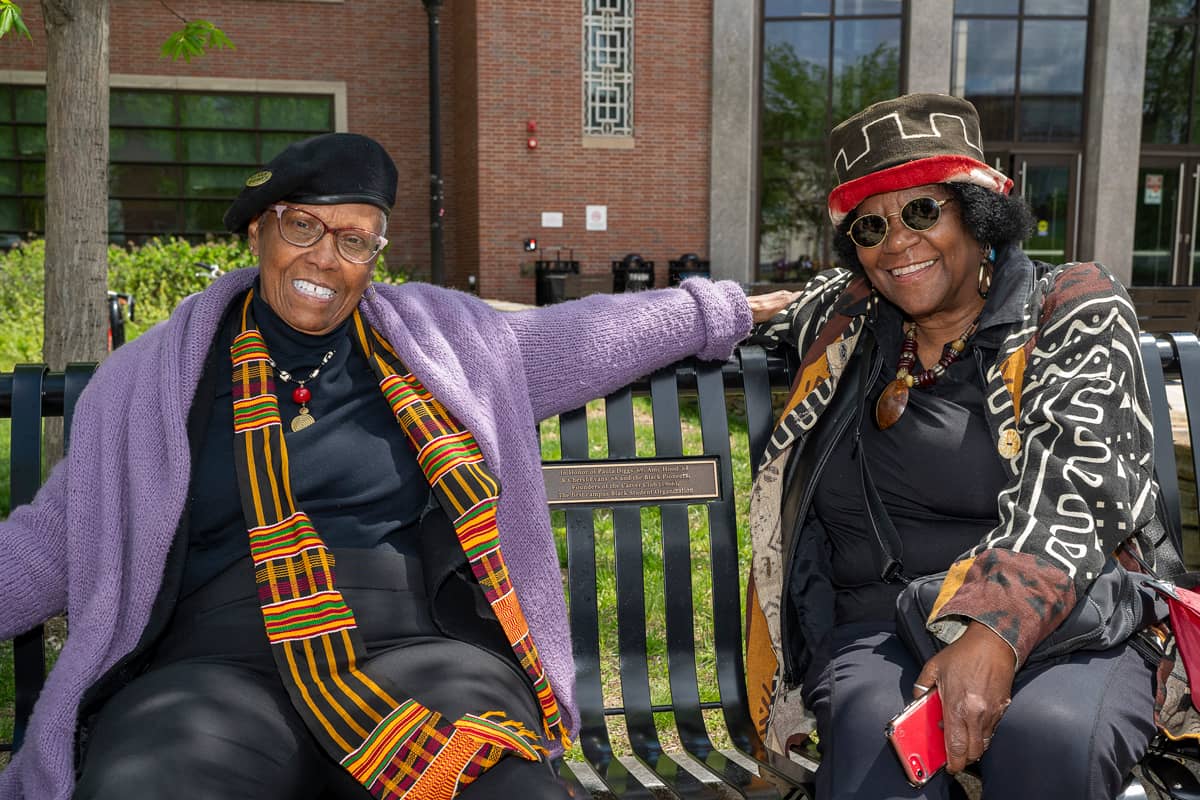
This spring, standing in front of the Student Union, Cheryl Evans ’68 dedicated a tribute bench to the UMass Amherst Black Pioneers—the Black students who attended the university between 1960 and 1970.
The bench also recognizes Evans, Paula Diggs ’69, and the late Amy Hood ’68 as founders of the Carver Club, the first Black student organization on campus.
“This is a very emotional experience for me,” Evans says.
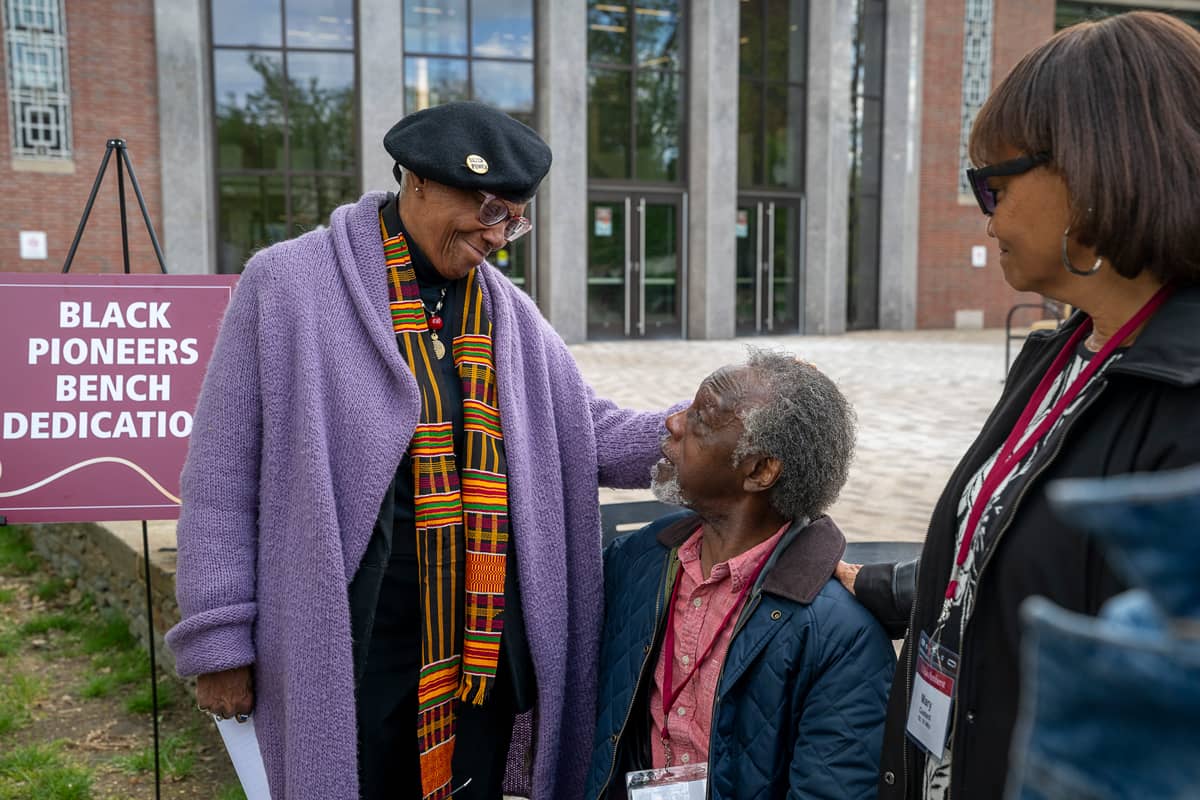
During the event, alumni embraced, shared stories, and reflected on how the Black Pioneers led efforts to increase diversity on campus during a decade marked first by scarcity and then by the determined growth of Black student life. Five Black Pioneers attended the celebration, including Evans, Francine Pope ’70, Charlie Player ’70, Cheryl Cruz Middleton ’69, and Nancy Woodfork ’70.
Wearing the same Black Power button that she wore to make a speech from the portico of the Student Union at the Martin Luther King Jr. Memorial Service in April 1968, Evans led a libation ceremony honoring classmates, mentors, and faculty members who helped build community and push for change.
“Each one of these people was dear to many of us. They paved the way,” Evans says. “It took about three years to make this bench happen...but I refuse to go down without something in our honor.”
A Bench Decades in the Making
The idea for the tribute emerged during a trip to Martha’s Vineyard, where Evans, Pope, and Diggs reminisced about their time as undergraduates living in Thoreau Hall, room 225. Evans and Diggs first shared the room with Hood, while Pope later lived there with Diggs, Carol Seales ’70, and Ingrid White ’73.
“For a couple of years, 225 Thoreau belonged to Black women,” says Evans. “And Paula said there should be a plaque outside of 225.”
Though the plaque became a bench, the intention stayed the same: to honor a group of students who made a difference.
“It feels like this is just one little, tiny thing—a bench—to say you were not invisible. You’ll never ever be again.”
Cheryl Evans ’68
Evans enrolled at UMass Amherst in 1964 as a first-generation college student from West Medford, Mass. She joined a freshman class of nearly 2,500 students that included only 12 Black students. At the time, UMass had fewer Black students than some southern universities and more students from Asia and Africa than Black students from Massachusetts.
“I used to walk across this campus and if I saw anyone tan, I’d wave,” Evans says.
Evans remembers advisors questioning her ambitions, professors criticizing her natural hair, and the burden of having to travel to and from her hometown just to buy necessities, like panty hose and makeup.
“In addition to trying to be a student and do papers and everything else, there were these constant microaggressions,” she explains. “We said, ‘We have to do something.’”
Advocating for Change
Evans and her classmates organized. They founded the Carver Club, later known as the Student Afro-American Organization. Evans was elected president, Cheryl Eastmond Bright ’69 was vice president, Diggs was treasurer, and Seales was secretary.
In 1966, they met with the dean of students and presented a proposal to increase the number of Black students on campus. Around the same time, faculty and staff launched the Committee for the Collegiate Education of Black Students (CCEBS), a recruitment initiative focused on Black, Asian, Spanish-speaking, and low-income students.
Two years later, after the first class of CCEBS students joined the university, students marched on the Whitmore Administration building to present 22 demands for change, including a call for a Black Studies program.
Their efforts helped lay the foundation for major institutional progress, including the growth of Black student recruitment initiatives, support programs, and the creation of the W. E. B. Du Bois Department of Afro-American Studies in 1970.
Pope remembers that transformation unfolding in real time.
“When there’d be a dance at UMass, nobody was asking you out,” Pope says.
“So we developed these great friendships that stayed throughout life. We had to depend upon each other.”
Francine Pope ’70
A sociology major, Pope says the emergence of Black Studies courses and faculty changed the trajectory of her education. Professors connected classroom learning to lived experience and challenged students to think critically about the world around them.
“They just made history come alive for us,” she says.
Those lessons stayed with Pope long after graduation. Her career took her from the Boston court system to juvenile justice work, prison education programs, Harvard Graduate School of Education, and community-based initiatives in Boston, Chicago, and many surrounding areas of both cities.
“You get involved with these young girls’ lives and realize some of the things you took for granted weren’t true for everybody,” Pope says.
Like Pope, Evans also transformed her experiences at UMass into a lifetime of public service and education. Over the next five decades, she worked in early childhood education, higher education, public advocacy, radio, and theater, all while mentoring students and educators.
Decades later, the experiences of the Black Pioneers have remained central to Evans’s life and work.
“I’m not doing this just for me. I feel the presence of our departed and of those who didn’t feel like they had a voice,” Evans says. “So, this is for them.”
Leaving Something Concrete
After a visit to campus in 2015, Evans realized how many stories were at risk of disappearing as classmates grew older and passed away. In 2016, she organized a reunion for the Black Pioneers.
That reunion became the catalyst for the UMass Black Pioneers Project, an initiative Evans launched in partnership with Special Collections and University Archives to record and archive the histories of Black students who attended UMass during the 1960s and early 1970s. Evans also donated the Cheryl L. Evans Papers, documenting more than six decades of her life as an educator, activist, performer, and organizer.
These projects helped reconnect alumni to each other and to campus. They also revealed the enormous impact the Black Pioneers went on to have as educators, scholars, business leaders, activists, and community builders.
“If you don’t record the stories factually, somebody’s going to write it later and change it,” Evans says.
Now 80 years old, she says seeing the impact of that work unfold in real time has been deeply meaningful.
“To be at this age and have the long view and see the fruit, it’s very emotional,” she explains. “We are leaving something concrete so we will never be invisible again.”
The bench now stands outside the Student Union, a permanent reminder of the students who worked to make UMass Amherst more inclusive.
“I hope students who walk by [the bench] someday sit down and ask: Who were the Black Pioneers?” Evans says. “I’m still here. And as long as I’m upright, the mission is to keep fighting.”
Help ensure stories like those of the Black Pioneers are preserved by making a gift to the Robert S. Cox Special Collections and University Archives Research Center.
- College of Social and Behavioral Sciences
- Revolutionize Access
- University Libraries
See how UMass is transforming access to education and empowering students to thrive.
- College of Natural Sciences
- Revolutionize Access
Alumna Supports the Next Generation of Microbiology Students
A UMass Amherst alumna established a scholarship to support the Department of Microbiology.
- Isenberg School of Management
- Revolutionize Access
Why Isenberg Seniors Keep Giving Back
For nearly two decades, Isenberg School of Management seniors have supported future students through the Senior Gift Campaign. This year’s class hopes to reach record participation while funding a new balance…
- Magnify Impact
- Marieb College of Nursing
- Revolutionize Access