
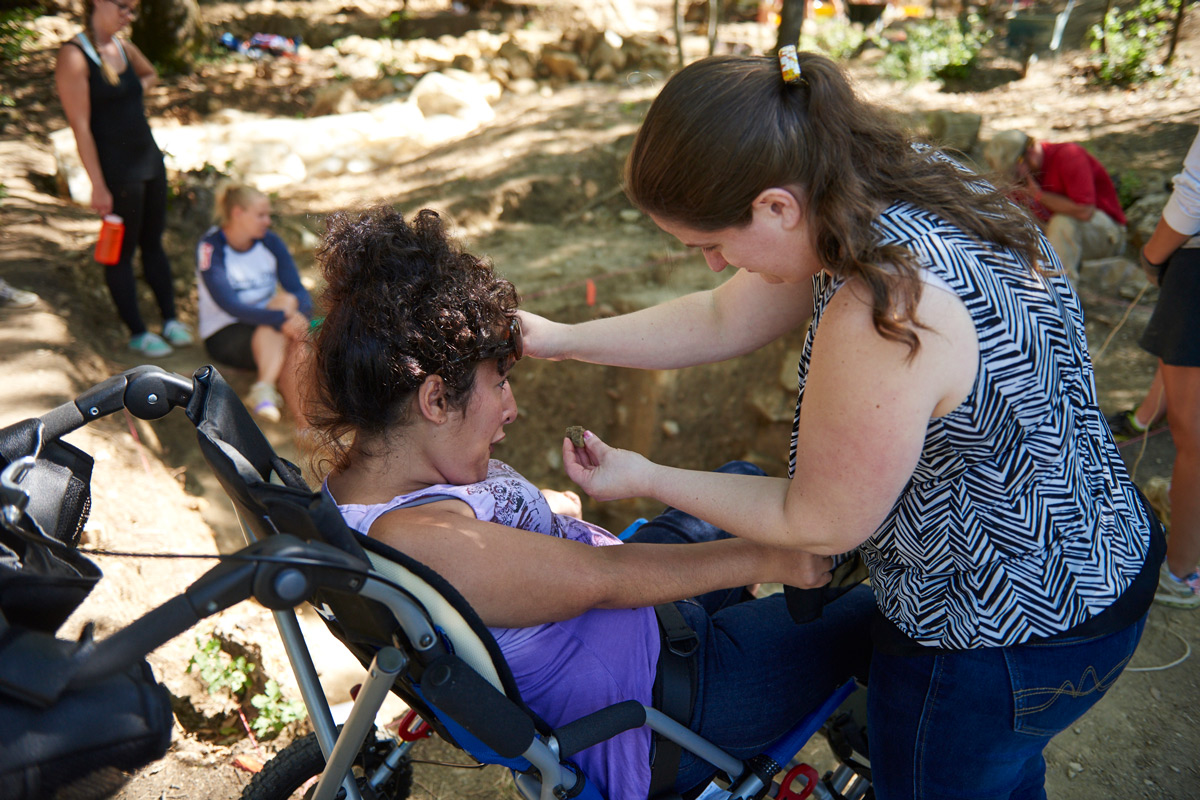
In the Classics courses taught by the late Caroline Horvitz, she often told her students: don’t take notes.
For Loren Isotalo ’24, who prides himself on being an avid notetaker, it was a big change. But it highlighted how Caroline wanted her students to be present, to think, and to fully engage with the material she taught. What they remembered later, she believed, would be what mattered.
“The lectures felt like the matriarch of your community was telling ancestral stories around the fire,” says Isotalo. “I always left her class feeling like my brain was working.”
That intentional approach to teaching now lives on through the Caroline H. Horvitz Professorship in Mediterranean Archaeology at UMass Amherst, established through a $1.5 million gift from her estate, which is managed by her father, Jeffrey Horvitz.
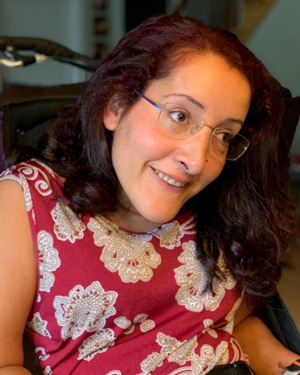
The gift honors Caroline’s wishes and her tenure as a respected lecturer in the Department of Classics. It ensures that her approach to teaching and discovery continues to shape how students encounter the ancient world.
Long before she was teaching at UMass Amherst, Caroline had built a life defined by curiosity, travel, and determination.
Caroline was born in Miami on May 16, 1988, with severe cerebral palsy and was profoundly deaf. After her family moved to Massachusetts in 1992, she began her education at the Beverly School for the Deaf.
To support her care and studies, Caroline’s family hired Cheryl Lauricella as her caregiver. Lauricella became essential to Caroline’s development, helping her communicate, adapt to the world, and pursue her educational goals all throughout her life.
Caroline went on to earn an associate’s degree from Mount Wachusett Community College, a bachelor’s degree from Mount Holyoke College, and two master’s degrees from Simmons College, where she wrote her thesis on Etruscan fibulae, an ancient ornamental pin used to fasten clothing.
In 2023, Caroline joined the UMass Amherst Department of Classics as a lecturer, teaching courses on Roman archaeology, Roman religion, and Pompeii.
As an educator, she developed a teaching style that required both precision and adaptability. She composed each lecture in full, delivering it in class through text-to-speech software, pausing to pose questions and invite discussion. Students’ questions were relayed back to her through interpreters, and her responses returned the same way. The process was complex, but it worked.
“Teaching became the center of her life, and she cared deeply about her students. Whatever her students learned about the class subject matter paled compared to the unstated lesson about what can be possible in life.”
Jeffrey Horvitz
Caroline was committed to teaching classes that mattered to students. She actively sought and incorporated their feedback into her courses. She held them to high standards while offering encouragement and guidance. At times, she would even bring ancient artifacts from her personal collection into class to enliven topics.
“She was a professional who cared a great deal, yet she didn’t take herself too seriously,” says Lauren Caldwell, chair of the Department of Classics. “It can be challenging to come across as competent, capable, and authoritative, while also human and relatable. She did a great job striking that balance. It put everyone at ease.”
“Teaching represented a professional zenith for Caroline. She was doing the thing she most wanted to do when she died. And one can only hope that we are all so fortunate.”
Anthony Tuck, Classics professor and associate dean for faculty and academic affairs
Yet Caroline’s impact extended far beyond the classroom.
She traveled to more than 80 countries, including Egypt, which her father says likely sparked Caroline’s lasting fascination with ancient cultures and artifacts.
With the help of her team, she parasailed over open water, flew in a helicopter, and even went skydiving. She served on the board of Safe Haven Therapeutic and Medical Outreach, supporting children in Cambodia with physical and medical challenges.
“Caroline was the most exceptional person I have ever known. She had a lot of drive, constantly pushing herself,” says Jeffrey. “I always wanted Caroline to have a life, not just an existence. Little did I know the life she lived would be as large as it was.”
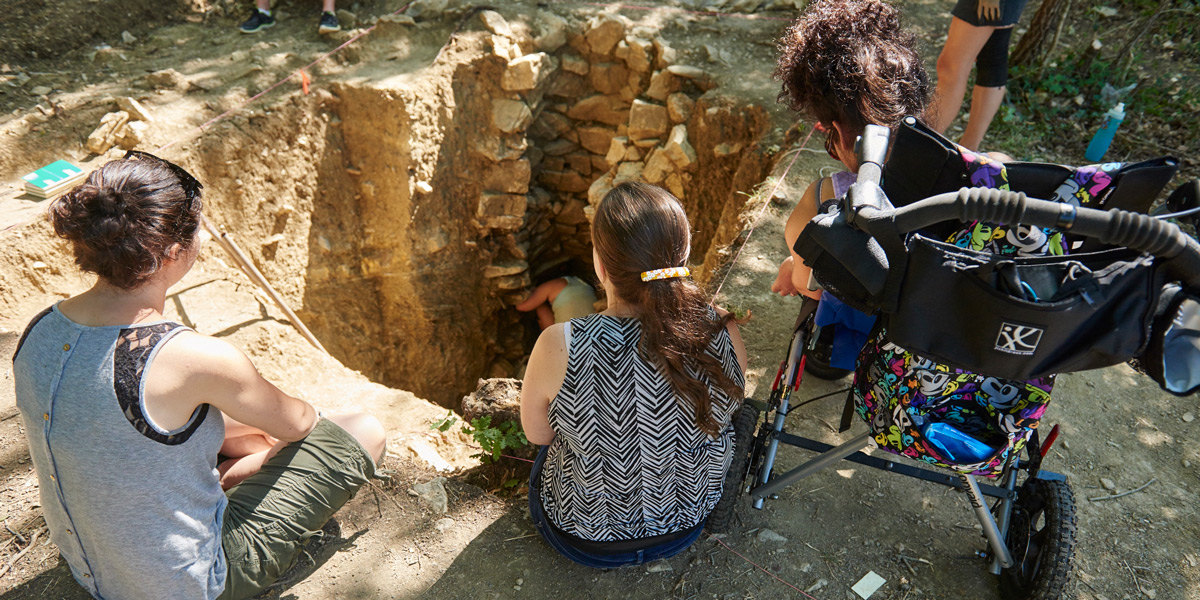
Caroline’s connection to UMass Amherst began through archaeological fieldwork. From 2015 through 2017, she worked at the Poggio Civitate Archaeological Field School in Italy, which is led by Tuck. There, she helped expand what participation in archaeology could look like.
“The truth is that Caroline was simply not in a position where she could climb down into a trench and excavate,” Tuck says. “But archaeology is much broader than that. All that's required is a little bit of creativity, patience to sort things out, and a willingness to take the risk and see where it leads you to make things work.”
Caroline cataloged Etruscan finds and contributed to digitizing the school’s archaeological archives. She also worked with Tuck to analyze wine drinking cups that had sculpted representations of fertility divinities on the handles. Together, they curated a show and authored a catalog for the Murlo Archaeological Museum.
“Archaeology is inherently an ableist field because so much of it is physical if you’re digging at a site. The travel, the work—they present a lot of challenges that most people never have to think about,” says Isotalo. “But Caroline spoke about them openly. She and her team felt like, if there are obstacles, we will overcome them.”
The Caroline H. Horvitz Professorship is designed to carry Caroline's passion, care, and life’s work forward. It will support faculty research, expand opportunities for student involvement, and help offset the costs of travel and fieldwork, ensuring broader access to the discipline. It will also strengthen the college’s academic reputation.
“A gift like this honors Caroline and recognizes that our programming in Classics prioritizes outstanding research and teaching,” Caldwell says. “Amid the doom and gloom we often hear about the humanities, this is a bright spot for our future and what we do.”
For Tuck, the professorship can offer a way to make archaeology more inclusive.
“When we're thinking about the question of access, we can't just consider physical challenges and limitations. Access can also be financial,” Tuck says. “Our hope is to reserve some of the funds for this professorship to support scholars coming into the field. It would be great if everyone, no matter their circumstances, thought to themselves, ‘This is something I could do.’”
Tuck adds that the professorship is an opportunity to emphasize the importance of the humanities and its inherently interdisciplinary nature.
“It’s not enough to be right about the value of this work. We have to be convincing,” he says.
Isotalo believes the professorship’s impact will be measured in who it brings to campus and how they teach.
“I hope it attracts someone who expands what we study and how we think,” Isotalo says. “Someone who connects with students in a way that makes them care.”
For Jeffrey, the hope ties back to his daughter’s gift for inspiring intellectual curiosity in others.
“Even if students don't go into the Classics field, I hope this professorship gives them an opportunity to learn about the topics Caroline loved,” says Jeffrey. “That the interest stays with them—when they go to a museum, or maybe their whole lives.”
Learn more about the Caroline H. Horvitz Professorship in Mediterranean Archaeology and make a gift to the College of Humanities and Fine Arts to strengthen teaching, research, and student opportunity.
- College of Humanities and Fine Arts
- Grow Investment
Discover how UMass is expanding its investment in research, teaching, and creativity.

- Grow Investment
- Magnify Impact
- Revolutionize Access
Accelerate Surpasses $600 Million
Thanks to the generosity of the UMass Amherst community, the campaign has reached an important milestone, 18 months ahead of schedule.
- College of Humanities and Fine Arts
- Grow Investment
Fueling Student Access to the Arts
Music has always played a central role in Hilda Greenbaum’s life. Her mother was a conservatory graduate. Her father took weekly opera lessons.
As a teen and young adult, she attended concerts and…
- College of Humanities and Fine Arts
- Grow Investment
- University Libraries