
In the wake of shrinking federal support for research, competition for grants from private foundations has skyrocketed. With two successful grant applications to the Spencer Foundation, the UMass College of Education is cultivating a relationship that could fuel transformative research for years to come.
In 2024, Jack Schneider, Dwight W. Allen Distinguished Professor in the College of Education and director for the Center for Education Policy, and his research team received a Spencer Foundation Vision Grant for their project: Transforming the Production and Use of Educational Data: Empowering Educators and Communities. In May 2025, Dr. Michael Krezmien and Dr. Ryan Wells, in partnership with the Massachusetts Department of Correction, were awarded a Spencer Foundation Vision Grant for their project: Disability Identification, Integration, and Inclusion (DI3) in Correctional Education.
“The Spencer Foundation Vision Grants aren’t just an important source of funding; they’re also prestigious,” says Marco Monoc, executive director of Foundation Relations at the UMass Amherst Foundation. “The Vision Grants are part of a two-step process, and they are meant to create change at the system level. They are for research that can have an influence on policy outcomes and practice.”
The two-step process involves using the Vision Grant to plan for a larger research project, with the potential to secure a Spencer Transformative Research Grant of up to $3.5 million.
As Schneider’s team comes to the end of its Vision Grant period, the award has enabled them to collect data to better understand Massachusetts’s current school improvement planning landscape. Using that data, they have developed a proposal for transforming the school improvement process and constructed interventions that will help all stakeholders—from students and parents to teachers and administrators—more fully engage in equitable and democratic planning and implementation.
“We’re taking this thing that exists in statute and we’re trying to figure out what kinds of systems and structures need to be put in place to breathe life into the school improvement planning process.”
Jack Schneider, Dwight W. Allen Distinguished Professor in the College of Education and director for the Center for Education Policy
Working with school districts from the Massachusetts Consortium for Innovative Education Assessment, which Schneider helped establish ten years ago, the group is now applying for the Spencer Foundation’s Transformative Research Grant to test out their theory of change.
“The hope is that by the end of five years, we would be able to say we developed this process working side by side with students, educators, families, community members, and district and school leaders,” says Schneider. “And by doing it in several different kinds of communities, we hope we’ll have a model that can be adopted anywhere in the Commonwealth.”
Equity is also a focus of Krezmien’s and Wells’s Vision Grant project, but in a very different setting. When reviewing existing research, they found there was almost nothing exploring how to identify those with disabilities in the adult correctional system and improve their educational attainment during their incarceration.
“What you see is a dramatically different population of students who've come in not just with disabilities but because of those disabilities, they have huge gaps in their learning and deficits that have accumulated over time,” says Krezmien.
The Vision Grant has enabled them to create a plan for developing, implementing, piloting and testing a better process for identification of people with disabilities and ways to enroll more of them in post-secondary education.
One of the ideas they are developing is a dual enrollment process that would allow incarcerated students who do not have a high school diploma or GED to work towards that at the same time.
“When we apply for the Spencer Transformation Research Grant, the idea is that would potentially fund the educators that would be teaching in concert with the correctional system’s already high-quality vocational teachers,” says Krezmien. “Then, we don’t have to ask the vocational teacher to manage the complexities of students with disabilities in their class.”
Dr. Bernie Audette ’88, director of inmate training and education for the Massachusetts Department of Correction, says this period of planning with Dr. Krezmien and Dr. Wells has been vital.

“All of the research shows that if you want students to not recidivate, they need to get out of the correctional system, get a meaningful job that has a career path, and earn a living wage,” he says. “So, the equity piece is the backbone of what we’re doing. Everything we’re doing is to open up more possibilities for them to be successful.”
Krezmien says that without the Spencer Vision Grant, they wouldn’t have been able to gather as much information on adult correctional education as they have, which has led to a paper they are preparing for publication and a possible convening of other education-focused foundations and researchers in spring of 2026.
“I think this is an appropriate type of partnership between a flagship state university and the state department of correction,” says Audette. “Creating more opportunities for incarcerated individuals is certainly good for the students but it’s also good for the community at large.”
Monoc, UMAF Executive Director of Foundation Relations, views these collaborations with the Spencer Foundation as just the beginning.
“It just shows that that there's so much innovation happening in the College of Education that is relevant to many different sectors of society,” he says. “Working towards system change is a big deal because private funders care about finding ways to address the root causes of a problem and develop models and potential interventions that can help improve education more broadly in this country.”
Visit umassfoundationrelations.org for more information on the work of UMAF’s Foundation Relations.
- College of Education
- Magnify Impact
Read more about UMass magnifying its impact on the common good.

- Magnify Impact
- Manning College of Information & Computer Sciences
Building Cyber Resilience
Arvind Nithrakashyap ’97 MS has used the knowledge he gained in software engineering, database management, and machine learning during his master’s program at UMass Amherst to establish and shape a globally…
- Fine Arts Center
- Magnify Impact
Opening Doors to the Arts
Nearly 800 elementary, middle, and high school students visit UMass Amherst to experience Latin culture, history, and dance through the Fine Arts Center’s Global Arts program.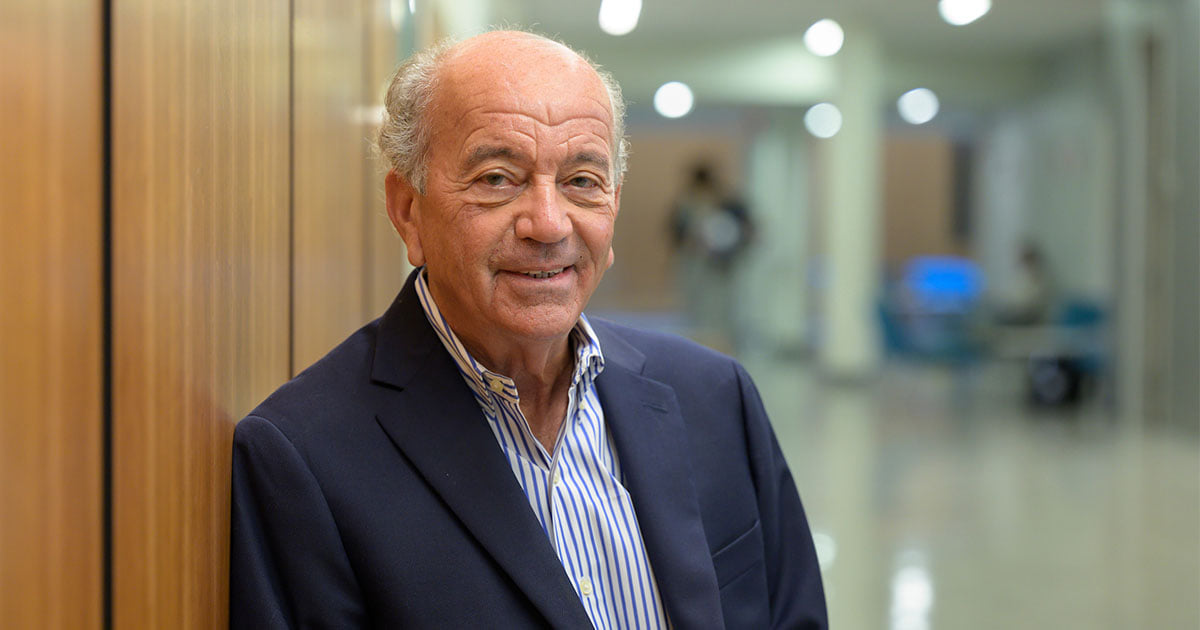
- College of Education
- Revolutionize Access