
Over the course of the past five years, college athletics has shifted from an amateur model into one where revenue is shared with players and student-athletes have the opportunity to earn compensation based on use of their name, image and likeness.
The consequences of these changes range from conference re-alignments to the unrestricted ability to transfer and the need for universities to reassess how to preserve the long-term financial stability and competitive strength of sports that do not bring in as much revenue as football and basketball.
At UMass Amherst, this turn of events has led to several changes throughout the Athletics Department, one of which is a central focus on increasing philanthropic funding for student-athlete scholarships and benefits across its 21 varsity teams.
In addition, the university recently placed responsibility for club-level sports under the Recreation and Wellbeing program within the Division of Student Affairs and Campus Life, moving it out of its previous home within the Student Government Association.
This wave of changes has inspired alumni of both varsity and club programs to launch grassroots fundraising efforts to ensure that future generations of student-athletes have the opportunity to participate in intercollegiate competition.
A Family Affair
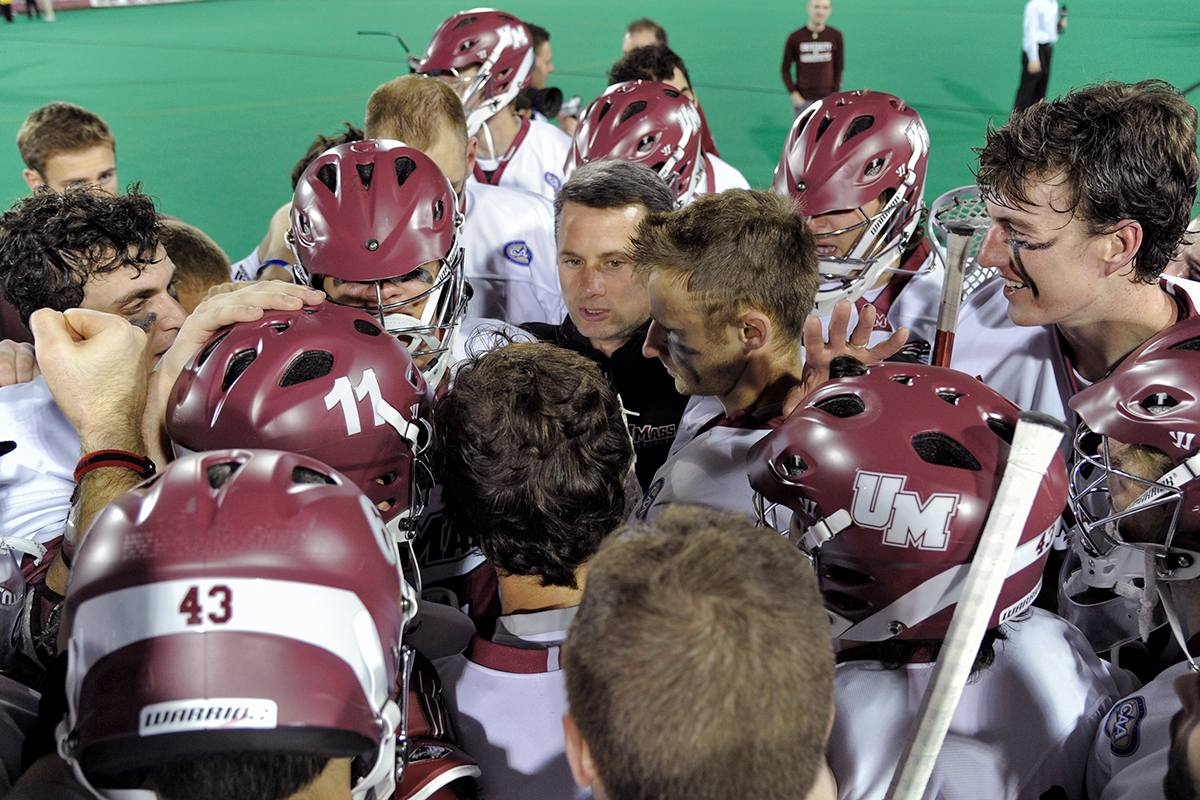
A few years ago, alumni of the UMass Men’s Lacrosse program were toying with the idea of starting a Name, Image and Likeness Collective, where alumni and fans could pool money and create paid endorsement or promotional opportunities for student-athletes.
But, on the national stage, the House v. NCAA settlement, which received final court approval in June 2025, ended restrictions on college athlete compensation and introduced direct school revenue sharing. It also removed the cap on how many scholarships one program could offer.
“We found there were benefits to going through the university instead of building a collective,” says Greg Rushing ’12, an alum of the program. “Gifts that donors make to the endowment are tax deductible. In some cases, gifts are matched 50 cents on the dollar. And the students receive money from scholarship endowments tax free rather than it being taxable income. So, it made sense to pivot with that legislation and focus on scholarships.”
Rushing began working with fellow alums Kelley Carr ’88 and Joe Reale ’10 to raise funding for a scholarship endowment that would support men’s lacrosse. As of August 2026, the group has raised a total of $1.3 million towards its goal of $3 million.
“The UMass lacrosse alumni community is a bit like a family. So, the receptivity to this has been phenomenal,” says Rushing. “Everybody wants to see the program succeed. We want to make sure they have what they need to compete.”

In April 2026, at a retirement celebration for longtime head coach Greg Cannella ’88 attended by many alumni and friends, the program announced that the scholarship endowment would bear his name.
“I was shocked to hear it,” Cannella says. “Now I feel a sense of pride and thanks to those who decided it should be in my name. It’s very humbling.”
Cannella is one of only four head coaches the program has had since its inception in 1954. Founding coach Dick Garber was his mentor, and Dick’s son Ted hired Cannella as one of his assistants when he took over. Over the course of his 31-year head coaching tenure, Cannella coached alumni from the class of 1992 through the class of 2025, including the current head coach, Kyle Smith ’14.
“Many alums, myself included, my father included [Norman Smith ’79], feel a debt of gratitude to the University of Massachusetts because of our experiences as lacrosse players,” says Smith. “Greg Cannella was an unbelievable coach, mentor, friend, leader, and representative of the school. As a coach, I feel fortunate to work at a school that has the capacity to do things like this because of what UMass Lacrosse means to so many people.”
Coaches Cannella and Smith recognize that fundraising efforts like this one are crucial to maintaining what they and the Garber family have built over the years.
“UMass Lacrosse has been a perennial top 10-20 team in the nation over the last 60 years. That’s pretty hard to do,” says Cannella. “Many lacrosse schools have invested so much into their infrastructure and overall budgets for their programs. In order to continue to compete, UMass must take those steps as well. This endowment is a huge step towards continued success.”
Investing in the Next Generation
This summer, the Division of Student Affairs and Campus Life officially brought 40 different club sport programs under the umbrella of its RecWell program. Although club sports don’t receive the same backing and promotion that varsity sports do, many of them are highly competitive, have extensive histories, and have previously relied on various levels of funding above what the RecWell program can offer.
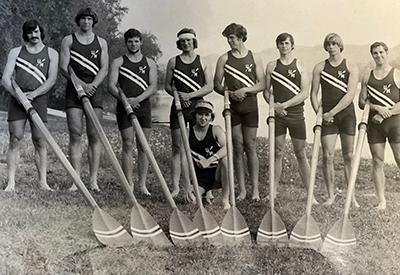
Men’s crew is one such program. In 1963, Bob Ford ’67 asked then Dean of Physical Education Warren McGuirk for help getting a men’s crew off the ground. At the time, McGuirk was unsure the program would gain traction, but he encouraged Ford to continue his efforts to recruit participants and drum up donations of equipment. His persistence paid off, and men’s crew officially became a Registered Student Organization in 1964.
“Crew is not a cheap sport,” says Ford. “You need boats, oars, a place to store equipment, travel funding, trailers to transport the equipment, and coaching.”
With a 62-year history, the men’s crew program has a deep well of alumni. Although participation has fluctuated over the years, the program has grown from 15 rowers in the early years to between 35-45 in more recent seasons.
Ford came together with Paul Gowen ’75, who is in the midst of writing about the early history of the crew program, and Rich Clair ’74 in November 2025 to solicit support among their generations’ crew alumni. Recently, Ford and Gowen helped to establish three endowments, including the multi-donor Friends of Men’s Crew at UMass Amherst Campus endowment. The group has set a goal of building these endowments (and possibly others) into a total $1 million endowment that would provide approximately $40,000 annually for the team’s needs not covered by RecWell funding.
“We’re trying to get older alumni to contribute,” says Ford. “Maybe they can make a planned gift to support the program in the future. This is a way for them to give back.”
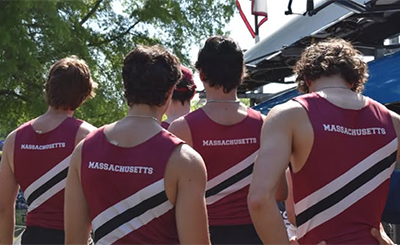
Many rowing alumni believe the crew program had a significant positive effect on them. As a result, Men’s Crew has also conducted successful fundraising for many years during the university’s UMassGives event, which coincides with Founders Day each April. This year, the group offered matching funds to motivate others to give. The program brought in 385 gifts totaling $43,793 and placed first overall among club sports.
Staff at the UMass Amherst Foundation have brought the engaged alumni together with representatives from RecWell and students involved in the current program to strengthen their fundraising strategy for the coming years. The overarching aim is to provide increased support for competition and long-term stability for the program.
“It’s great to see that something we put so much effort into to get off the ground in the 1960s is still going strong today,” says Ford. “Rowing is not easy itself, and rowing and studying together is almost impossible. But today’s crew participants are succeeding at it. They are a cut above, and we want to support them.”
You can support promising UMass Amherst student-athletes today by making a gift to the Greg Cannella Fund for Men’s Lacrosse or the Friends of Men’s Crew at UMass Amherst Campus endowment.
- Athletics
- Revolutionize Access
See how UMass is transforming access to education and empowering students to thrive.
- College of Social and Behavioral Sciences
- Revolutionize Access
- University Libraries
Honoring UMass Amherst’s Black Pioneers
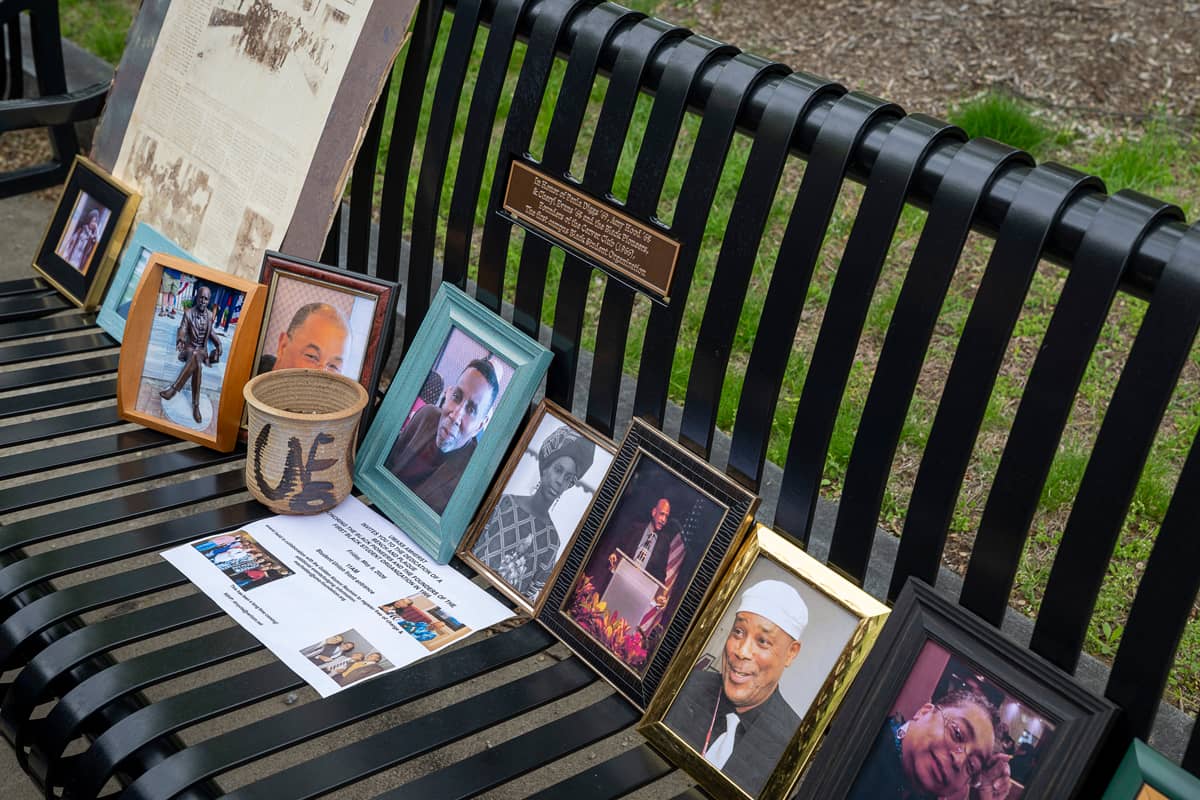
This spring, Cheryl Evans ’68 and the UMass Amherst Black Pioneers were honored with a tribute bench recognizing their efforts to expand Black student life, increase recruitment, and shape lasting…
- College of Natural Sciences
- Revolutionize Access
Alumna Supports the Next Generation of Microbiology Students
A UMass Amherst alumna established a scholarship to support the Department of Microbiology.
- Athletics
- Revolutionize Access