
Through the University Libraries Sustainability Fund, donors are investing in interdisciplinary teaching, research and action to address sustainability issues on and beyond campus.
On April 29 and 30, the University Libraries raised more than $9,000 during the university’s annual online giving campaign, UMassGives 2026. The Libraries work across campus is varied and supports all STEM disciplines, business education, humanities, and performing and visual arts. But its UMassGives fundraising highlighted the Libraries Sustainability Fund, which empowers students, faculty, and researchers to tackle today’s most pressing environmental, economic, and social challenges.
Donors who support the Sustainability Fund help the Libraries invest in scholarly collections that support sustainability research and education, public exhibits and events that engage the campus and community, and academic programs that enable students to explore sustainability topics. This includes more than 300 sustainability-related courses and the interdisciplinary work of the UMass Amherst School of Earth and Sustainability.
“The response to UMassGives was wonderful. In just 48 hours, our community came together to invest in sustainability research, education, and student success,” says Dean of University Libraries Curtis Brundy. “These gifts directly support student researchers, expand collections, and strengthen programs that prepare the next generation to address climate change, environmental justice, and sustainable development. I'm grateful to every donor who made this possible.”
As the largest state-supported academic library system in New England, the UMass Amherst University Libraries strives to move forward research, knowledge development, and community partnerships in sustainability areas that run the gamut, from agriculture, animal sciences, and food systems to coastal management, forestry, and landscape architecture. The dedicated sustainability fund ensures that resources are available to support this crucial work.
Empowering Sustainability Scholars
One of the most visible initiatives supported by the fund is the Undergraduate Sustainability Research Awards. These awards, which range from $1,000 to $2,500, promote in-depth understanding of sustainability topics, research strategies, and the use of library resources, providing participating students with vital skills they will carry into future academic and professional endeavors.
This year, the Libraries presented awards to three individuals and two teams. All winning projects will be added to the Sustainable UMass Student Showcase collection in ScholarWorks.
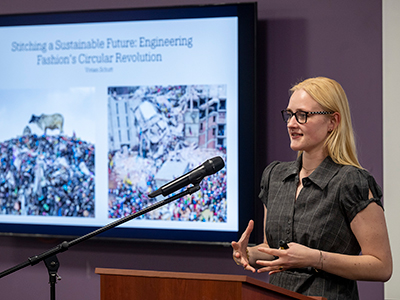
Award recipient Vivian Schutt ’26, a mechanical engineering major based her project, “Stitching a Sustainable Future: Engineering Fashion’s Circular Revolution,” on her interest in the intersection of engineering, sustainability, and design.
“I was particularly drawn to topics that connected engineering with industries that are not always associated with traditional engineering work, such as fashion and consumer products,” she says. “As part of my project, I developed a mock-up concept called Beyond Zero Waste, which emphasized reuse, material efficiency, and waste-conscious design.”
Schutt says that beyond the physical resources the University Libraries provide, staff also encourage students to explore connections between fields, which was especially important for a project that combined the physical and life sciences with art.

Matthew L'Ecuyer ’26, another mechanical engineering major says he relied heavily on the resources at the Science and Engineering Library for his project: “Experimental Validation of Natural Ventilation Driven Heat Loss Model in a University Residential Building.”
“[My] methodology can be applied to any building experiencing overheating to reduce energy bills and carbon footprint,” he says. “But the problem is especially prevalent on college campuses with old residential buildings and antiquated temperature controls.”
Demonstrating the diversity of projects these sustainability awards support, Ilana Hebert ’27 focused her project on PFAS─often called “forever chemicals”─in the Merrimack Valley.
“One of my interests is pollution, and I would like to understand it from a particular perspective, one which contextualizes history and material culture,” she says.
Using both environmental science methods and archaeological approaches in the field, her research emphasized that the legacies of toxic pollutants are both global and local problems on differing scales, and their effects are unevenly distributed among people.
“[UMass Amherst] is a great place for collaborative efforts in sustainability research precisely because there are so many departments and people with diverse perspectives and ideas to bring to the table.”
Ilana Hebert ’27
Cora Attias-Inzano ’26, who won an Undergraduate Sustainability Research Award in 2025 for her exploration of Beech Leaf Disease, agrees. “Academic research can be intimidating; but I have found that the sustainability community here at UMass Amherst is always encouraging student participation in research and makes an effort to ensure research opportunities are accessible to all students.”
Community-wide Seed Sharing
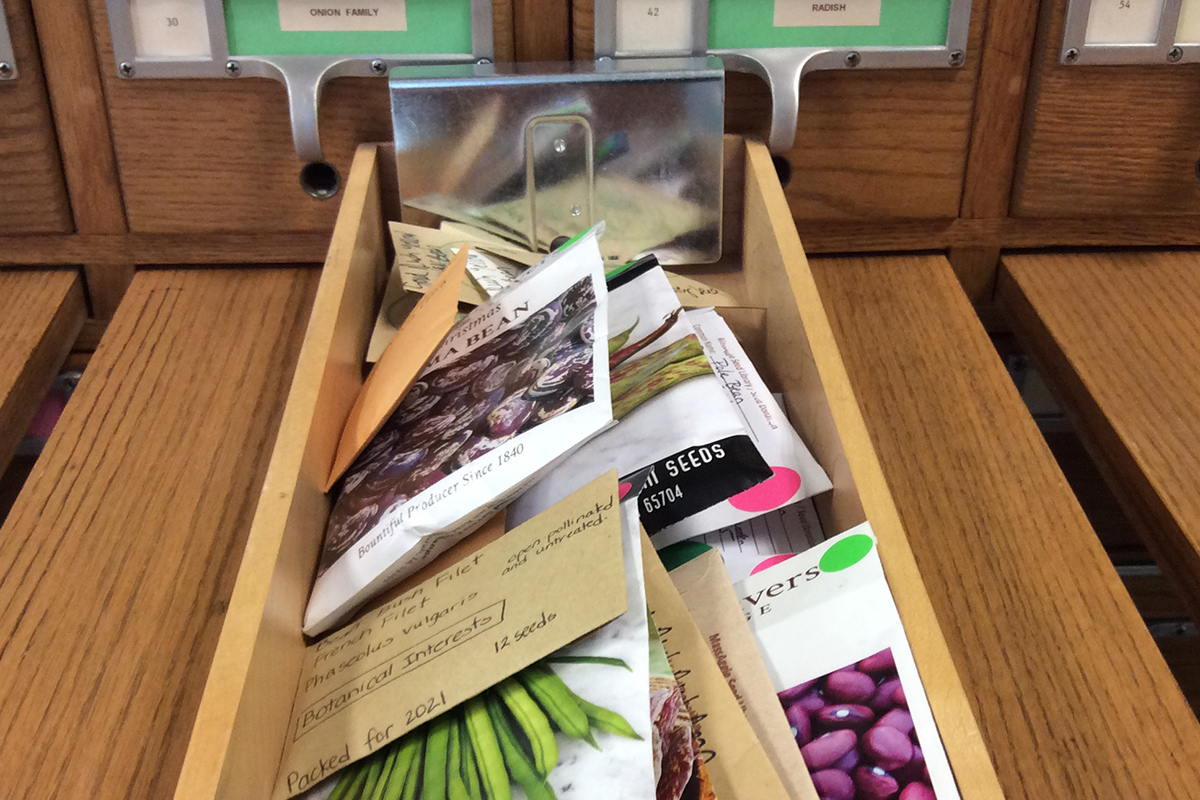
The Libraries Sustainability Fund also supports the Mass Aggie Seed Library and the Herb Library @UMass. The Seed Library, named to honor UMass Amherst’s origins as an agricultural college, collects and distributes organic open-pollinated and heirloom seeds. Many of the seeds are donated by community members and agricultural companies, and no library card is needed to take or return seeds.
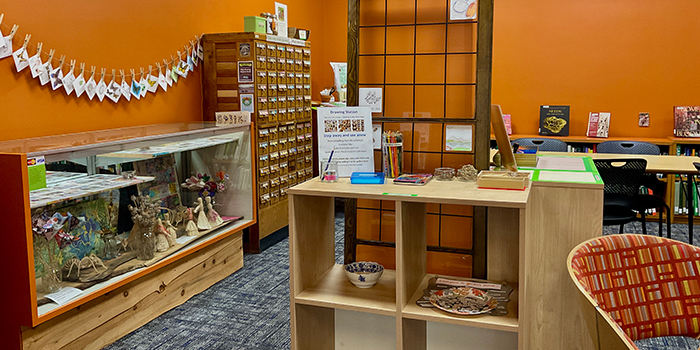
The Seed Library also shares growing resources, holds seed workshops, and stages exhibits related to nature and agriculture. Its Common Seed Project has taken off since its inception in the summer of 2024. Librarian Paulina Borrego, who oversees the Mass Aggie Seed Library, has worked with other librarians and volunteers to “cultivate community through a shared growing experience—promoting sustainable gardening practices with seed saving at its core.”
Participants across Massachusetts can get free seeds from 42 participating academic or public libraries, along with access to local events, workshops, and resources. The common seed for 2026 is the Hopi Black Dye Sunflower.
The Seed and Herb Libraries share space in the Science and Engineering Library. The Herb Library is a logical extension of the University Libraries’ work in this area and is inspired by the People's Medicine Project, a grassroots health justice organization based in Western Massachusetts.
“The Herb Library is another example of UMass Amherst’s commitment to wellness within the common good,” says Herb Librarian Madeleine Charney. “In this colorful and welcoming space, workshop participants created tea blends, incense, body salt scrub, aromatherapy spray, and art with plant dyes.”
Investing in a Sustainable Future
Through these activities and more, the University Libraries and its Sustainability Fund support an unmatched level of teaching, research, scholarship, and innovation related to sustainability. This strong foundation in sustainability education and practice is at the core of UMass Amherst’s ranking at no. 9 in the Princeton Review’s Guide to Green Colleges, becoming the only public university in New England to make the top ten.
In order to ensure that the Sustainability Fund and the greater collections of the University Libraries can continue to serve aspiring scientists and researchers, five longtime Libraries champions─Paul Murphy ’73, Marda Buchholz ’65, Vanessa Cieslak ’76, Bruce Cherner ’80, and Shawn Lorraine─generously matched $2,000 in gifts to the Libraries during UMassGives 2026.
“Whatever your major, you most likely made use of the Libraries’ offerings,” says Buchholz. We would love to see more alumni join us in showing appreciation for this unsung but necessary resource.”
Want to support sustainability research and community efforts at UMass Amherst? Make a gift to the Libraries Sustainability Fund today.
- Magnify Impact
- University Libraries
Read more about UMass magnifying its impact on the common good.
- Grow Investment
- Magnify Impact
- Revolutionize Access
Accelerate Surpasses $600 Million
Thanks to the generosity of the UMass Amherst community, the campaign has reached an important milestone, 18 months ahead of schedule.
- College of Education
- Magnify Impact
Catalyzing Educational Innovation
In the wake of shrinking federal support for research, competition for grants from private foundations has skyrocketed. With two successful grant applications to the Spencer Foundation, the UMass College of…
- College of Humanities and Fine Arts
- Grow Investment
- University Libraries